How we integrate plastic moulding into complete projects: from design to scalable production.
Imagine a customer approaching us with an idea: an electronic enclosure that will require hundreds or thousands of units per year. The immediate temptation might be to jump straight into injection moulding. But we’ve learned that the shortest path is not always the optimal one.
At MCS, injection moulding follows a clear philosophy: it’s not an in-house process, but a technology we manage through qualified external partners. This strategic choice sets us apart: we do not offer third-party molding services, but propose this solution only when it is integrated into projects we fully develop and manage.
When Moulding Becomes Part of Our Value
Before proposing injection moulding, we assess several key prerequisites. We prefer projects where we are responsible for the product design—not for the sake of control, but to ensure design coherence. Only by starting from the design phase can we guarantee optimization for downstream processes.
Of course, we also work with customers who already have a valid project—or one that requires only minor adjustments for moulding—and are looking for a partner to integrate additional processes.
Our goal is to complement injection moulding with coordinated operations from our internal portfolio, such as:
- screen printing;
- laser marking for traceability or customization;
- digital printing;
- aesthetic or conductive painting;
- application of labels, display covers, membrane switches, and mechanical parts;
- complementary assembly activities.
In this way, the mould becomes part of a production ecosystem where we can ensure total control, certified quality, and tangible added value.
Optimizing Geometries, Enhancing Design: The MCS Approach to Moulds
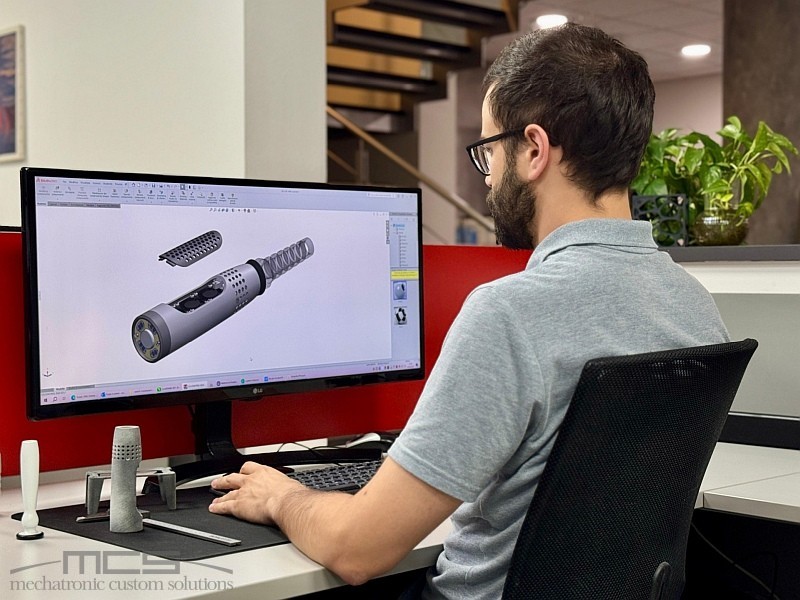
Our two decades of experience have shaped a distinctive approach. We often design enclosures with closed, simplified geometries that are later refined via CNC machining to create openings, connectors, key slots, and specific variants.
The benefits of this method include:
- simplified mould design by eliminating slides and complex movements;
- significantly reduced mould cost;
- greater flexibility for handling minor design variants;
- post-moulding customization without modifying the mould itself.
The Evolutionary Path: From Prototyping to Series Production
Most of our projects start with alternatives to injection moulding:
- CNC milling from solid blocks, for dimensional precision and superior finishes;
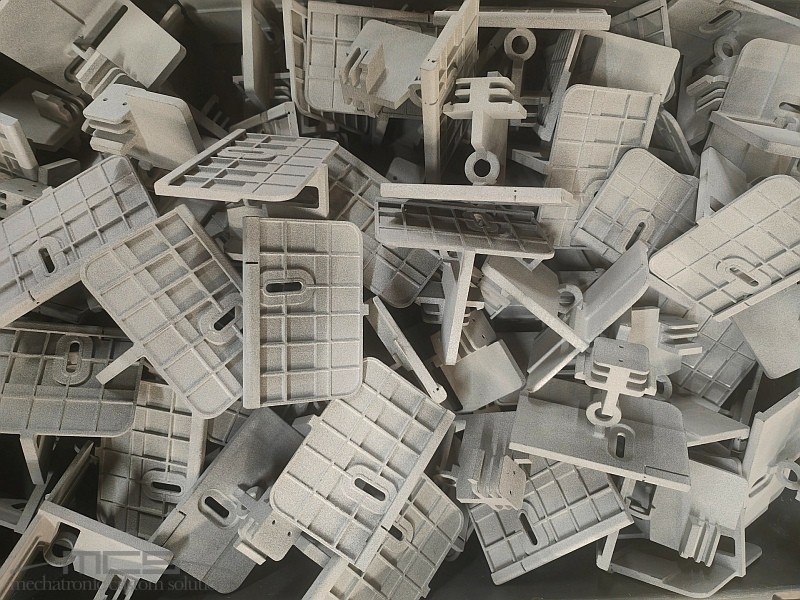
- 3D printing in PA12 using MJF technology, ideal for complex geometries and fast turnaround.
These methods are perfect for:
- small-to-medium production runs;
- early market testing;
- initial functional and assembly tests;
- trade shows or commercial presentations;
- fully functional samples.
When a product proves commercially successful and volumes grow, we evaluate the transition to plastic moulding. This may require:
- a complete redesign to optimize manufacturability;
- or a simple design adjustment, if moulding was anticipated from the start.
The MCS Method: Pre-Series, Testing, and Scalable Production
Our approach eliminates the downtime typically associated with mould creation.
We produce small batches using CNC or 3D printing. The unit cost is certainly higher than moulded parts, but this method usually provides real added value, allowing the customer to:
- start selling or validating the product immediately;
- generate revenue while the mold is being built (typically 2–3 months);
- avoid dead time and accelerate time-to-market;
- test the market with finished products, not just prototypes.
The Advantages of Moulding Within the MCS System
Integrating moulding into our production flow creates tangible benefits:
- lower unit costs on medium-to-large runs, as all processes are managed by a single supplier (quite different from having a separate supplier for moulding, painting, digital printing, etc.);
- fast production with the ability to plan medium-to-large batches;
- seamless integration with our internal processes—painting, printing, marking, and assembly;
- operational continuity through pre-series batches while the mold is being built;
- cost optimization through design tailored to post-processing.
When Injection Moulding Doesn’t Make Sense
Injection moulding requires a careful economic evaluation. Beyond the unit cost, the initial mould investment can vary significantly depending on part geometry, required finishes, technical complexity, and number of cavities.
These are non-recurring costs that must be amortized over the projected number of parts.
Indicative parameters for considering moulding:
- at least 500–1,000 pieces per order;
- minimum of 500 units/year in consumption;
- repeatability over at least 3 years.
When these parameters are uncertain, we prefer starting with CNC or 3D production: more flexible and with zero tooling investment.
A Conscious Choice
At MCS, injection moulding is never a stand-alone commodity, but a component of integrated projects.
Those seeking a basic moulding service will certainly find other suppliers more suited to their needs.
But those looking for a partner capable of turning an idea into a complete, optimized, and scalable product will find the right answer in us.
Our approach ensures not just production, but the entire journey from concept to market—with the flexibility to adapt to product evolution and commercial success.
To assess whether your project can benefit from our integrated approach, contact us for a preliminary technical evaluation.